

In a recent conversation with Dr. Connie Zweig, we explored a question that naturally emerges after years of healing, self-examination, and shadow work:
What happens after awareness? What comes after we identify the wound, uncover unconscious patterns and shadows?
That question became the foundation for our discussion around light work and the ideas explored in my new book, The Light Work Journal.
Early in the conversation, Dr. Connie offered a definition that captures the heart of the practice:
“There is this innate part of us that shines. That sparks, connects, and creates. But what happens is it gets blocked. It gets stuck. It gets covered over, it gets masked. Part of light work is removing the illusions that cover over our inherent light. And that is a deeply spiritual proposition. It’s not only psychological.”
- Dr. Connie Zweig
For many years, the cultural conversation around inner work and self-help has focused primarily on shadow work and trauma healing. Bringing the unconscious into consciousness, confronting trauma, examining behavioral patterns, and increasing self-awareness. These practices have become incredibly valuable tools for helping people understand themselves more deeply. Shadow work, in many ways, creates the foundation for transformation because it allows people to identify the forces operating beneath the surface of their lives.
However, one of the recurring questions that emerged from readers of The Shadow Work Journal was surprisingly simple: what now? After the awareness arrives, after difficult truths are uncovered, how does someone move forward? How do they begin rebuilding their inner world instead of only excavating it?
The practice for light work emerged from this exact tension point. While shadow work helped illuminate unconscious material, light work began to feel like the next phase of the process: expression, embodiment, participation, and creation.
Dr. Connie described light work as “a method for cultivating a new stage of yourself.” That framing is important because healing is not solely about analysis. At a certain point, transformation requires movement. It requires action, participation, and the willingness to embody the wisdom gained through inner work.
One of the central ideas discussed throughout the conversation was the distinction between analysis and participation. Modern culture encourages constant observation and interpretation of the self. Many people spend years studying psychology, consuming self-help content, analyzing their emotions, understanding attachment styles, and tracing behavioral patterns back to their origins. While these tools can create profound insight, insight alone does not always create change.
There comes a point where the process must move beyond understanding into lived experience. Light work emphasizes participation in life rather than endless observation of it. This can take many forms: creative expression, meaningful action, honest communication, contribution to the community, or taking risks aligned with one’s values and authentic self to propel growth.
Another major theme in the discussion centered around the concept of the “spark,” or what many people describe as their sense of aliveness.
"As far as we can discern, the sole purpose of human existence is to kindle a light of meaning in the darkness of mere being." (Jung, 1963, p. 326)
- Carl Jung
It has become so common for people to say they feel as though they have “lost their spark.” This language reflects something broader occurring in culture. Many people are not necessarily in a visible crisis but instead feel disconnected, stagnant, numb, or spiritually exhausted.
This idea became especially apparent as I reviewed anonymous emotional check-in data from the Zenfulnote app. One of the most commonly reported emotional states was not sadness or anger, but tiredness. That finding reflects a broader cultural condition in which people often function, perform, and survive, but do not necessarily feel deeply connected to themselves or to life itself.
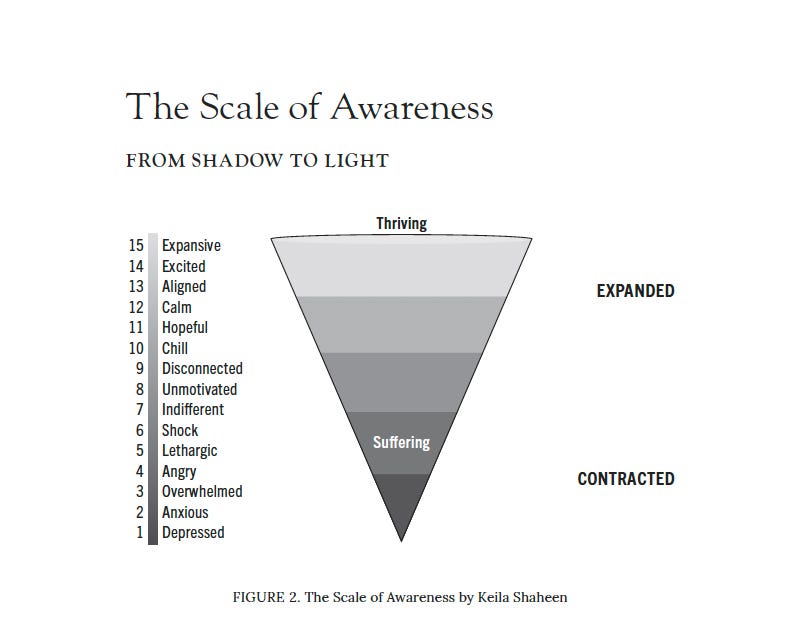
This observation also informed the creation of the “Scale of Awareness” included in The Light Work Journal. The scale functions as an internal map that helps individuals identify where they are emotionally and energetically so they can better understand which practices or tools may support them in the moment. As Dr. Connie noted during the conversation, emotions can “color the psyche,” making it difficult for individuals to separate themselves from the emotional state they are experiencing. The map is intended to create greater awareness and perspective, helping people recognize that emotions are experiences moving through them rather than fixed identities.
Our discussion also explored the spiritual dimension of light work. While psychology often focuses on the mind, wellness culture frequently focuses on the body, and both Dr. Connie and I discussed how the spirit is often overlooked in modern life. In this context, spirit does not necessarily refer to religion, but rather to the deeper human need for meaning, creativity, connection, vitality, and purpose.
Light work, therefore, is not positioned as an alternative to shadow work, nor as a bypassing of pain or difficulty. Instead, it represents another aspect of the same developmental process. Inner work is not linear. There are periods when shadow awareness is needed and periods when light awareness is equally essential. Psychological growth requires the ability to hold both realities simultaneously: the wound and the wisdom, the darkness and the spark, introspection and participation.
Where are you in your stage of life and level of conscious awareness? Leave a comment or join our chat community below to share with us!

Thank you for reading and bringing your curiosity here. If you feel inspired and ready to begin cultivating more light awareness in your life, you can find The Light Work Journal here.
With gratitude,
Keila & Dr. Connie
🖤 Thanks for reading Shadow Work to Expand Awareness: a space where inner work meets the outer world through shared prompts, writings, and livestream conversations with Dr. Connie Zweig, Ph.D and Keila Shaheen.
Support our work:
– Get the Zenfulnote App to make inner-work part of your daily life
– Keila’s books: The Shadow Work Journal · The Lucky Girl Journal · The 369 Journal · The Book of Shadow Work · The Light Work Journal NEW!
– Dr. Connie’s books: Meeting the Shadow · Romancing the Shadow · Meeting the Shadow on the Spiritual Path · The Inner Work of Age– Keila’s website: www.keilashaheen.com (access free meditations here)


